
Standards
Validate (≥ 500 px/m) at Night: Why Open Areas Require Linear Lighting, Not Whip Lamps
3 min readcctvfinder
For open outdoor areas that must be secured at night via video surveillance and meet the Validate (Ermessen) quality level of ≥ 500 px/m under DIN EN IEC 62676-4:2026-10, color imaging is mandatory according to sound technical principles. To guarantee color imagery at requisite forensic quality, homogeneous illumination via linear lighting fixtures is indispensable. Conventional point light sources, frequently installed as curved whip lamps, represent a fundamentally flawed methodology here.
Normative foundation: The new 7-tier O2DCPVS framework
DIN EN IEC 62676-4:2026-10 introduces a revised, seven-tier pixel density classification (O2DCPVS: Overview, Observation, Detection, Control, Recognition, Identification, Validate). The benchmark tier Validate requires ≥ 500 px/m and governs verification of known individuals, behavioral tracking, and automated license plate recognition (ALPR). At this granular detail threshold, chromatic data possesses independent probative value in court, such as establishing suspect textile dyes or vehicle paint coats.
| Quality Tier | Pixel Density | Typical Application |
|---|---|---|
| Validate (Ermessen) | ≥ 500 px/m | Verification, license plates, behavior |
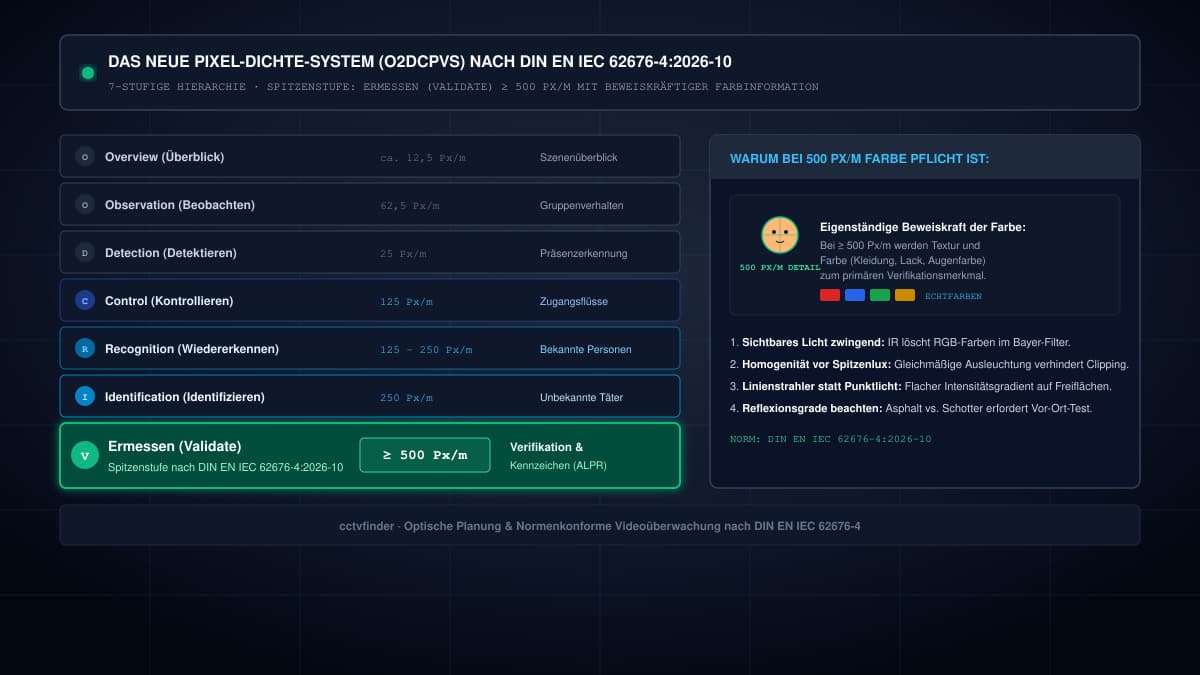
At ≥ 500 px/m, color becomes a primary evidentiary discriminator: In the absence of visible color wavelengths, forensic verification reliability collapses.
Technical justification: Why point lighting fails and linear arrays succeed
1. Color images require visible spectrum: Pure infrared illumination yields greyscale recordings because IR wavelengths illuminate all three RGB channels of a Bayer filter simultaneously, destroying chromatic separation. Color imagery demands either visible spectrum lighting or specialized low-light sensors operating in color mode – ideally matched to a color temperature of 6000 Kelvin.
2. Point lighting generates severe non-uniformity: Whip lamps act as point light sources whose radiant intensity drops quadratically with distance (1/r²). Across open ground, this induces an extreme illumination gradient – high-intensity center hotspots bordered by dark peripheral dropouts. At 500 px/m, overexposed center pixels clip into pure white, while underexposed peripheries drown in thermal sensor noise. Useful resolving detail is permanently lost in both regimes.
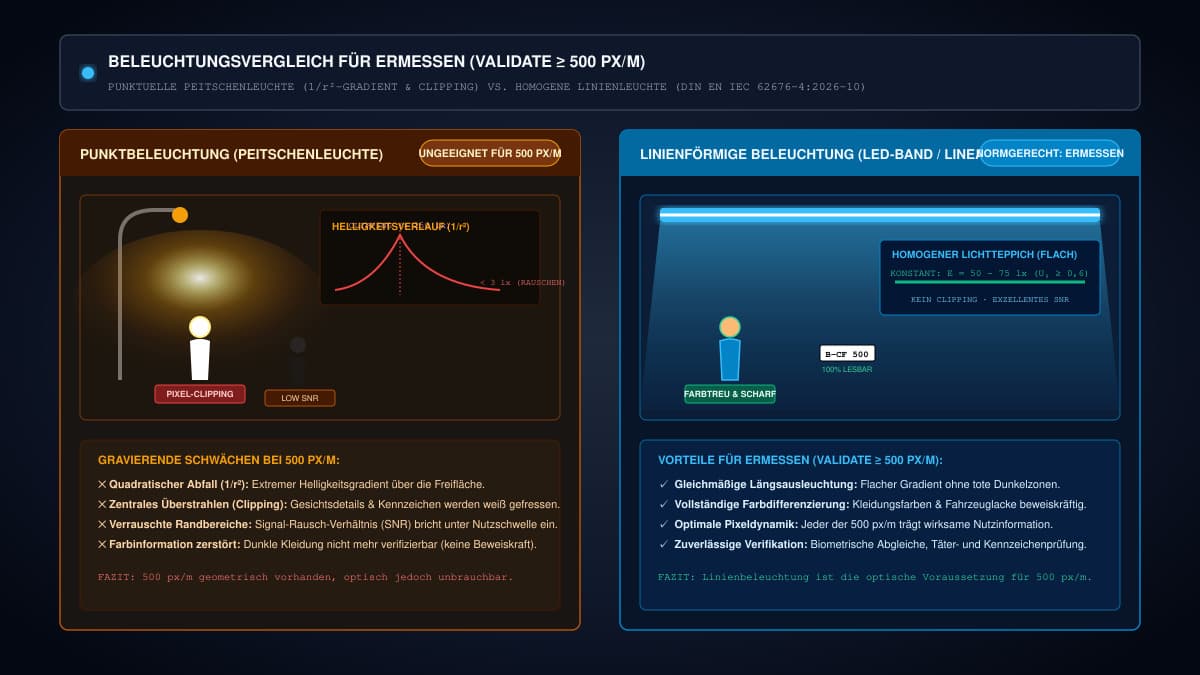
3. Linear illumination as an optical prerequisite: Continuous linear fixtures, such as LED light strips or linear asymmetric floodlights, project uniform lux levels along their longitudinal plane. Combined with appropriate mounting height and beam inclination, this produces an exceptionally flat uniformity gradient. To sustain ≥ 500 px/m effectively across an entire field of view, homogeneous lighting is the primary optical prerequisite.
When subjects deliberately employ optical camouflage or textured adversarial garments – as detailed in forensic analyses of anti-surveillance fashion – only the combination of high target pixel density and uniform full-color illumination exposes minute seam contours and fabric textures.
Practical engineering constraints for project deployment
Translating standard requirements into real-world installations demands adherence to three critical physical constraints:
- Pixel density is purely a geometric metric: 500 px/m measures only the geometric projection on the subject plane. Under deficient or uneven illumination, actual optical resolving power falls substantially short due to sensor noise and shutter lag.
- Linear geometry alone is insufficient: Proper photometric engineering remains vital. Without precise matching of mounting height, luminaire pitch, and beam aiming, linear systems also produce localized hotspots and intermediate dark voids.
- Project-specific verification is mandatory: Ground reflectance (dark asphalt versus pale gravel), ambient luminance, and camera tilt heavily dictate real-world SNR. Photometric computer modeling or empirical on-site testing is indispensable to prove compliance.
Verify your planned camera focal lengths and mounting heights in our interactive 3D planning tool to ensure your perimeter corridor maintains the required 500 px/m under stable optical conditions.
Read next
Optimal Lighting and Color Temperature for Outdoor CCTV: 3000 K vs 6000 Kelvin
3000 K or 6000 K for outdoor areas? Why 6000 Kelvin daylight white is essential for accurate color identification, lower noise, and courtroom evidence.
4 minSecurityFail-Safe CCTV for Critical Infrastructure: Lightning Protection, HVI Lines, and Hardened Transmission
Comprehensive protection for critical CCTV networks: Why HVI down-conductors, multi-stage surge arresters, and optical fiber ensure continuous recording.
3 min