
Lighting
Optimal Lighting and Color Temperature for Outdoor CCTV: 3000 K vs 6000 Kelvin
4 min readcctvfinder
When securing industrial perimeters, logistics yards, or outdoor car parks at night, lighting determines image quality far more than camera megapixels alone. But security specifiers often debate color temperature: cozy 3000 Kelvin warm white or crisp 6000 Kelvin daylight white? From an optical and forensic perspective, the answer is unequivocal: 6000 Kelvin is strictly preferred in all outdoor security applications. Why warm lighting distorts vehicle and clothing colors, forces CMOS sensors into noise-amplifying gain traps, and how to engineer lighting geometry under DIN EN 62676-4 is detailed below.
Color temperature comparison: Why 3000 K fails courtroom scrutiny
Warm white illumination at 3000 Kelvin is widely favored in domestic architectural design for its warm ambiance. In forensic video surveillance, however, it represents a severe operational liability: 3000 K contains predominantly red and yellow wavelengths, while short-wave blue photons are virtually absent. While human vision automatically compensates for amber tints through chromatic adaptation, CMOS camera sensors lack this perceptual flexibility.
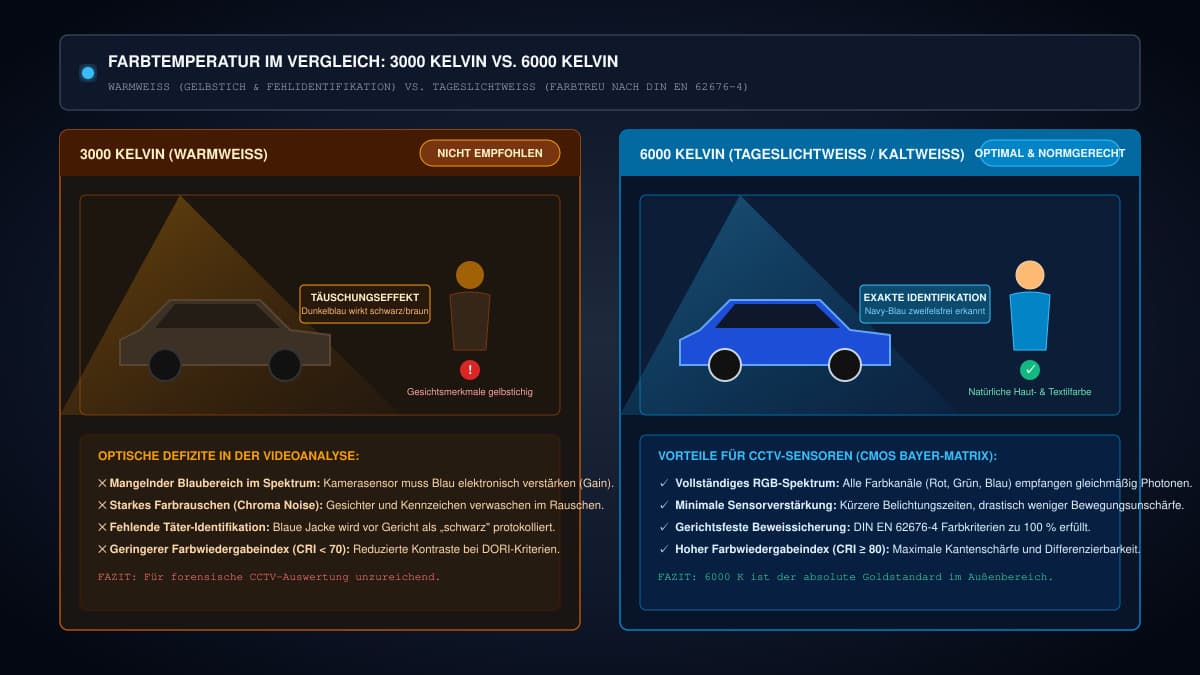
When 3000 K light strikes a navy blue jacket or a getaway car, the surface cannot reflect blue light because none is present in the illumination beam. The sensor registers the object as muddy charcoal or black. Eyewitnesses and investigators search for a black sedan when the perpetrator actually escaped in a royal blue car. Under 6000 Kelvin daylight white, by contrast, the sensor receives an evenly balanced spectrum: hues render faithfully just as they appear in full sunshine.
For court-admissible forensic suspect identification under DIN EN 62676-4, 6000 Kelvin is indispensable. 3000 K causes severe color confusion on dark textiles, misdirecting investigations.
Sensor physics: How 6000 K drastically curtails image noise
Security cameras use CMOS sensors fitted with a Bayer color filter matrix (50% green, 25% red, 25% blue photodiodes). Under 3000 K light, the blue photodiodes are severely starved of photons. The camera firmware attempts to rebalance white point calculations by aggressively boosting analog and digital gain (high ISO). The penalty is destructive chroma noise and lost edge acuity across critical facial details.
As detailed in practical reviews of security cameras with night vision, spectrally inadequate artificial illumination inevitably forces camera DSPs into temporal noise reduction (DNR) or slow shutter speeds. A person walking at 25 metres is turned into a useless, smeared blur.
With 6000 Kelvin illumination, high-energy photons strike all RGB filter wells evenly. The camera maintains minimum sensor gain and fast shutter speeds (at least 1/50 to 1/100 second). Motion blur disappears, and facial contours retain forensic edge clarity.
Illumination geometry: Uniformity and anti-glare placement on open perimeters
Even optimal color temperature is squandered if luminaire geometry is flawed. High-output floodlight cannons pointed straight into a scene create blinding specular highlights and pitch-black perimeter shadows that overwhelm the dynamic range (WDR) of any camera.
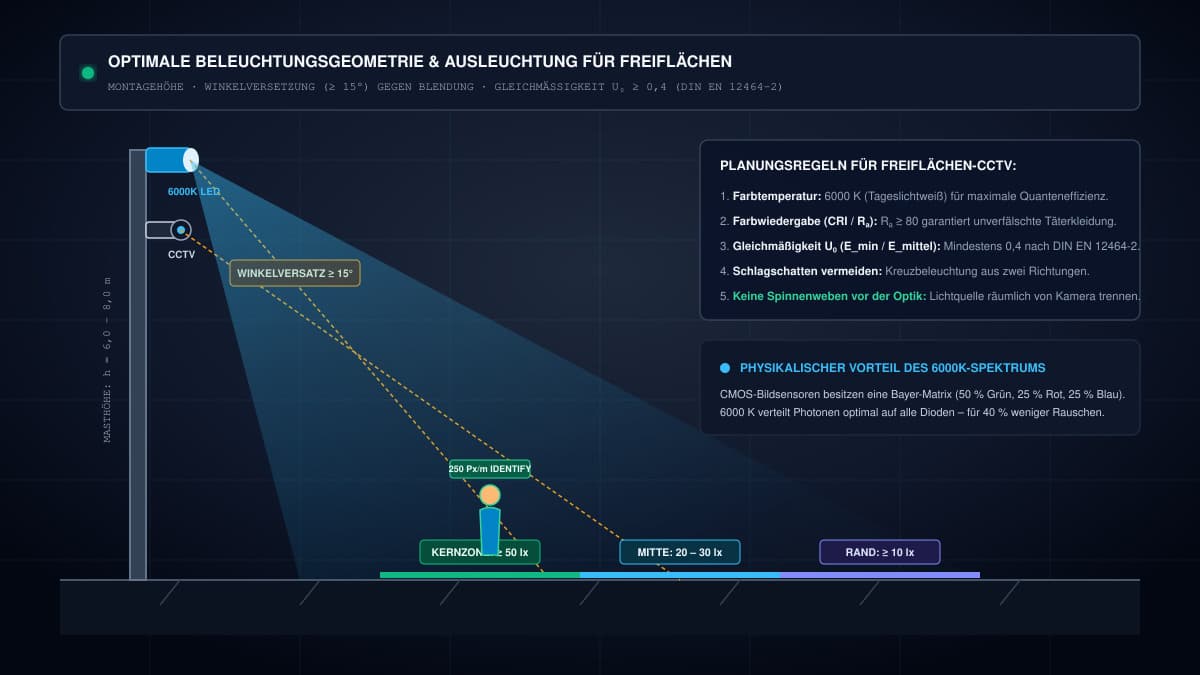
Professional open-area illumination engineering (DIN EN 12464-2) adheres to four core principles:
- Uniformity U0 >= 0.4: The ratio of minimum to average illuminance (E_min / E_avg) must not fall below 0.4 to prevent dark visual voids between lighting poles.
- Target lux standards: 10 to 20 lux suffices for general perimeter detection (Detect/Observe). For court-admissible identification under DIN EN 62676-4 (250 px/m), target areas require 30 to 50 lux at face level.
- Angular offset >= 15 degrees: Mounting LED luminaires immediately beside the camera lens creates blinding backscatter in rain, fog, and snow. Separating fixtures also prevents nocturnal insects and spider webs from obscuring the lens.
- Color rendering index (CRI / Ra >= 80): High Ra values ensure that subtle textile tones and skin complexions remain distinguishable.
As demonstrated by modern video surveillance systems deployed across industrial infrastructure, combining continuous 6000K ambient illumination with event-triggered spotlights produces optimal situational awareness: Quiet areas stay discreetly illuminated, while tripwire triggers flood the perimeter with cool white light for immediate perpetrator deterrence and evidence capture.
Explore our guide on night vision and IR range to see when visible white light outperforms infrared illumination, and calculate your required coverage corridors using our interactive 3D planning tool.
Read next
Validate (≥ 500 px/m) at Night: Why Open Areas Require Linear Lighting, Not Whip Lamps
Validate (≥ 500 px/m) under DIN EN IEC 62676-4:2026-10: Why homogeneous linear illumination is essential for court-admissible night-time color surveillance.
3 minSecurityFail-Safe CCTV for Critical Infrastructure: Lightning Protection, HVI Lines, and Hardened Transmission
Comprehensive protection for critical CCTV networks: Why HVI down-conductors, multi-stage surge arresters, and optical fiber ensure continuous recording.
3 min