
Security
Fail-Safe CCTV for Critical Infrastructure: Lightning Protection, HVI Lines, and Hardened Transmission
3 min readcctvfinder
When a lightning bolt strikes a 12-metre outdoor camera mast, a few microseconds decide the survival of the entire security perimeter. In critical infrastructure facilities such as power sub-stations, water utilities, or logistics hubs, stormy weather must never compromise video surveillance or central recording. Purchasing premium cameras without engineering the physical path from air-termination rod to operations center invites catastrophic hardware destruction. True operational resilience demands high-voltage insulated (HVI) conductors, coordinated surge suppression, and galvanic optical isolation.
The perimeter vulnerability: When lightning strikes camera masts
Perimeter camera columns act as prominent lightning rods across open industrial terrain. A direct strike unleashes lightning impulse currents of up to 100,000 amperes (100 kA) with rise times measured in microseconds. When standard bare down-conductors are mounted alongside cameras without respecting physical separation distances, lightning energy sparks over onto camera housing mounts or data cabling.
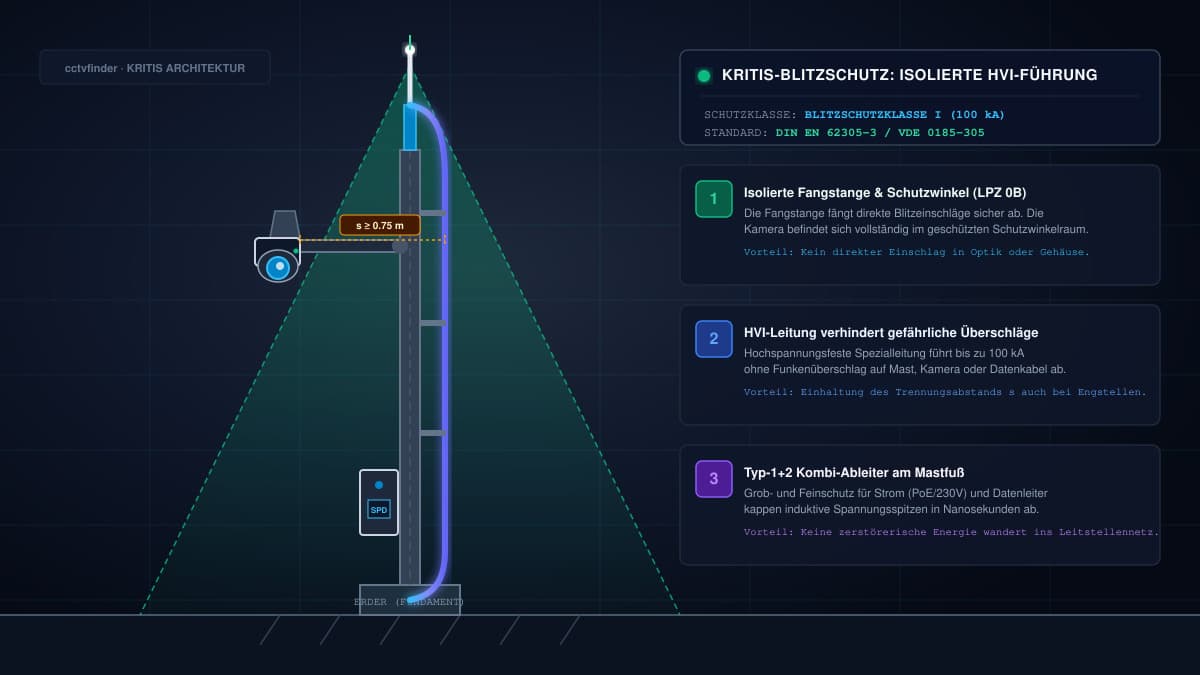
Such flashovers instantaneously melt camera image sensors, Ethernet physical transceivers, and PoE switches. Modern perimeter security engineering therefore relies on high-voltage insulated down-conductors: As explained in the specialist guide on lightning protection for CCTV via HVI conductors, dedicated HVI cables contain electric field stresses within special semi-conductive layers. This allows direct installation along camera masts while preventing destructive sparkovers to adjacent low-voltage circuits.
Outdoor cameras must always be placed within Lightning Protection Zone LPZ 0B beneath isolated air-termination rods. Direct connection to lightning-carrying metalwork destroys sensitive optics.
The unbroken transmission chain: From mast base to control room
Effective mitigation cannot stop at the camera head. Ground strikes generate severe transient potential rises that travel along copper conductors for kilometres into operations buildings. Connecting outdoor cameras directly to central server rooms via twisted-pair copper cables creates an accidental lightning conduit.
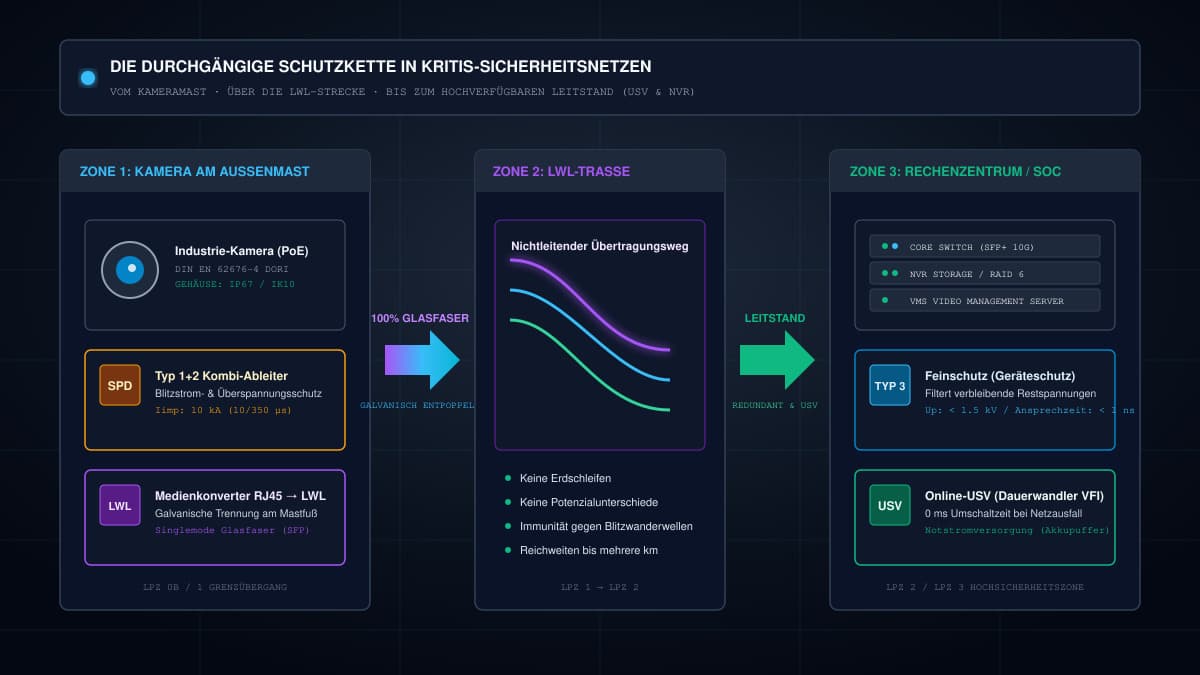
Resilient critical infrastructure architectures deploy a coordinated three-stage transmission defense:
- Stage 1 – Heavy Surge Arresters (Type 1+2 combined): Housed in outdoor mast junction enclosures to divert raw surge currents straight into foundation earthing electrodes.
- Stage 2 – Galvanic Fiber Isolation (LWL): Ethernet signals convert immediately to optical fiber at the mast base. Because optical fiber is completely non-conductive, traveling surge waves cannot enter central buildings.
- Stage 3 – Fine Device Suppression (Type 3) and Online UPS: Residual transients are clamped within sub-nanosecond intervals at the server rack. An online double-conversion UPS guarantees uninterrupted NVR recording through grid voltage sags.
Equipotential bonding must be addressed holistically across all substations, as emphasized in engineering studies of lightning protection systems in power utility infrastructure: Inconsistent earthing potentials between remote perimeter posts and power distribution cabins generate dangerous circulating currents during ground faults.
Standards compliance and high availability under DIN EN 62676-4
Optical precision according to the DIN EN 62676-4 standard delivering 250 pixels per metre for identification is useless if video feeds cut out during critical weather emergencies. European infrastructure frameworks mandate uninterrupted surveillance availability even during severe thunderstorms.
| Protection Zone | Thunderstorm Threat | Required Mitigation | Governing Standard |
|---|---|---|---|
| Mast Top & Camera | Direct lightning flashover | Isolated air rod with HVI cable (LPZ 0B) | DIN EN 62305-3 |
| Mast Base & Power | Induced electromagnetic surges | Type 1+2 combined arresters (PoE / 230V) | DIN EN 61643-21 |
| Field Run to Building | Ground loops and traveling waves | Galvanic isolation via optical fiber | VDE 0800 / EN 50173 |
| Control Room & NVR | Grid outages and switching spikes | Type 3 arresters and online double-conversion UPS | DIN EN 62040-3 |
Evaluate prospective mast heights and coverage corridors early in our interactive 3D planning tool, integrating structural lightning conductors and optical routing into system blueprints from day one.
Read next
Optimal Lighting and Color Temperature for Outdoor CCTV: 3000 K vs 6000 Kelvin
3000 K or 6000 K for outdoor areas? Why 6000 Kelvin daylight white is essential for accurate color identification, lower noise, and courtroom evidence.
4 minStandardsValidate (≥ 500 px/m) at Night: Why Open Areas Require Linear Lighting, Not Whip Lamps
Validate (≥ 500 px/m) under DIN EN IEC 62676-4:2026-10: Why homogeneous linear illumination is essential for court-admissible night-time color surveillance.
3 min